Friday, November 7, 2014

Sabbatical - What's in a name?

I have been doing some thinking, reading and meditating on the concept of Sabbatical over the past few months. This has been part of my own personal Getting Ready before we left the US, and part of my process now that we are here in Oaxaca.

The first thing that was helpful was watching the TED Talk, "The Power of Time Off" by Stefan Sagmeister. The speaker has developed a practice of taking a full year Sabbatical every 7 years. He says he wasted the first one for lack of structure, and did much better on his second one by having a weekly schedule, like the ones we had back in school. I took this advise to heart, and came up with a rough plan for my time, though I will say life does not always cooperate with your plans and theories. Still, I find it helpful in making sure my time is spent intentionally, not eaten up by email and FB. :-)

The second thing that was helpful for me in Getting Ready was that Travis Norvell (our pastor at Judson Church in Minneapolis) loaned me a couple of books on the subject.   "The Sabbath: Its Meaning for Modern Man" by Abraham Joshua Heschel gave me a view of how the Sabbath is observed and experienced from a Jewish Rabbi's point of view. Heschel refers to the Sabbath as more than just a day to relax in preparation for another day of work, but as a taste of eternity. He says that the coming of the Sabbath is greeted ceremoniously as a bride is greeted on her wedding day.  "Receiving the Day: Christian Practices for Opening the Gift of Time" by Dorothy C. Bass explored the practical, modern aspects of practicing a weekly Sabbath. She points out that Sabbath is about saying "no" to say "yes" (not a new idea), and that the saying "no" is at times not easy. Sarah and I are trying to clear away time on Sundays to spend together doing nothing much except taking leisurely walks and talking.

El Pedregal ("The Rocky Field"),
the permaculture site where I am volunteering this winter.

A Sabbatical to me is different from a vacation. A vacation is a break from work where you maybe get out of town, rest, do as little as you like, indulge yourself, and then come back to work, hopefully refreshed and ready to go. A Sabbatical, on the other hand, is not just a break FROM, it is a break TO - in order TO do something. We have been to Oaxaca twice before on vacation, and we had a great break FROM work, sleeping in, eating in restaurants, seeing the sights, trying out our Spanish. But this time we are here more TO do things - TO volunteer, TO improve our Spanish, TO meet people and in my case TO explore new vocational possibilities. We expect this Sabbatical to to change us, not just refresh us.
My commute.

The parents of some of Hannah's friends came to visit for "Dia de Muertos", and they used a term to describe what we are doing that I had not yet heard ..."Mid-Life Gap Year"…but I am not sure it fits as well for me as Sabbatical. I am certainly in "Mid-Life", so that fits. But to borrow the term "Gap Year" from high school kids who delay starting college doesn't really work for me. First, the kids presumably know what they are going to do the following year, maybe even where they are going. And I have to admit the suspicious parent in me thinks they are just trying to delay having to do the work required of a college student, and to prolong their childhood dependency on their parents another year! So I guess for me the word Sabbatical has weight and power, whereas "Gap Year" sounds like something missing from your resume.

Whatever you call it, this is an experience that everyone should be able to have, that everyone deserves, but few ever get. I think everyone should be given a year off when they turn 50. Few are "given" a Sabbatical, but I encourage anyone who can pull it off to "take" one.
Just a friendly reminder that
nobody lives forever


Sunday, November 2, 2014

Día de Muertos


The hostess at one of our favorite restaurants.
Apparently silicone survives death.
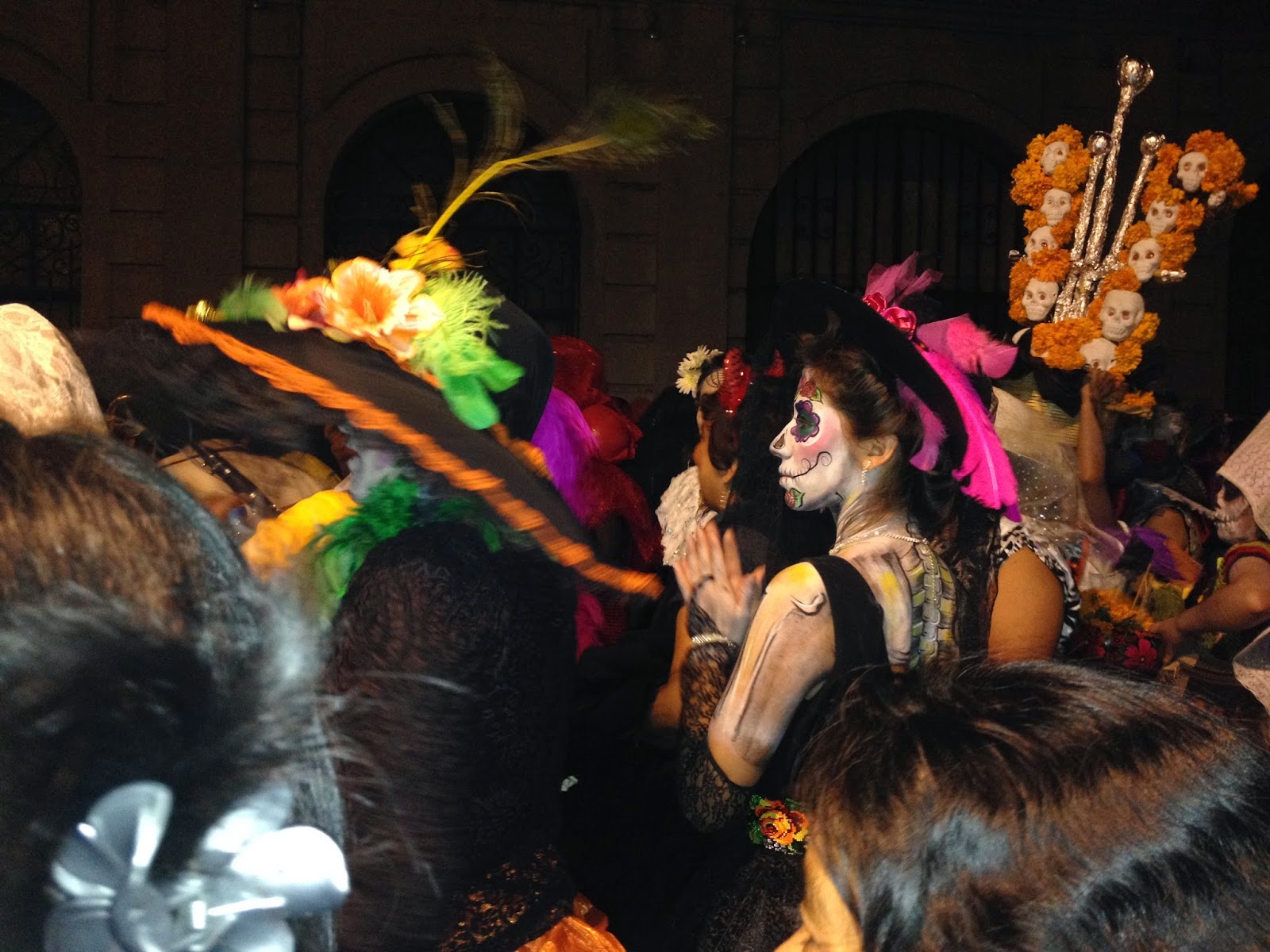
One of the celebrations Oaxaca is well-known for, in addition to Night of the Radishes (I can't wait for that one!), is Day of the Dead. The streets are teeming with tourists anxious to experience this 3-day spectacle which includes parades, fireworks, costumes, decorated altars, tapetes de arena (sand carpets), and visits to local cemeteries.

Death as an extension of life.
Beginning on October 31, people begin preparing for the return of the spirits of deceased loved ones. Gravesites are cleaned and decorated with marigolds, celosia, lilies and candles. Families gather together at the site, eating, drinking, remembering, and ocassionally playing music and singing. Día de los Angelitos is celebrated on November 1, in rememberance of infants and children, and on November 2 all others are honored

A typical alter with the favorite foods of the deceased. After
the deceased has consumed the "essence" of the food, the
family can dig in.


We've been swept up in it all.  Friday night we went to the cemetary in Xoxocotlan (nicknamed Ho-Ho) to see the decoration of the gravesites. I couldn't believe what met us there; street musicians, hawkers selling all sorts of illuminated props, strangers offering us shots of mezcal, a stage with performers (including some traditional Tunas from Spain). And some of the altars created at the tombs were incredible.

These new friends were anxious to share
their beer with us!
Parade of the Catrinas on Saturday night.


This is all what I had been prepared to expect. Ironically, what I hadn't expected was the grief. Most families seemed serene, even joyful, as they decorated and tended their loved-ones graves but there were some who were expereincing the raw pain of loss. With a lot of people watching them. But what surprised me most was the grief that I felt at the sight of the lonely graves, the ones that were not decorated and seemed forgotten, especially when they were next to those that were so lovingly cared for. Randy and I bought a bunch of marigolds, put flowers on some of those bare spots and wondered what the stories were behind them.
Many of the crypts in the San Miguel cemetery hold remains
of "desconocidos" or unknown people.

 My Dad died almost one year ago and Randy's Mom has been gone for 7. We created an altar for them in our casita, with the traditional sugar skulls, candles and favorite foods. I spent time thinking about what my Dad liked in life, great times we had together, sayings he had ("It's better than I deserve," "I fell uphill," "There's nothing better for you").  The atmosphere in Oaxaca has helped to keep his memory close these days.
Our alter included art supplies and candy
 for Judy; coffee and peanuts for my Dad.

A tapete de arena, or sand carpet.
Día de Muertos is such an odd combination of grief, celebration, entertainment, reflection, letting go and holding on. Just like life, I guess.


Monday, October 27, 2014

Trees Of Oaxaca - the "Guage" tree

OK, so this post is not for everybody. In fact, maybe it's just for Mike Larson, my self-proclaimed plant geek friend. And maybe for Hannah, my only kid who has even pretended to take an interest in trees.

Being a bit of an aspiring plant geek myself, and recognizing almost none of the trees here in Oaxaca, I am making it a mission of mine to learn to identify at least some of the more common trees here. There are lots of trees that look like legumes, with their compound leaves and beans of one sort or another. They remind me a bit of the honey locust and black locust trees you see back in Minnesota.

But whereas in Minnesota you might see one or two legumes among the vast majority of maples, oaks, birch and pines, here in Oaxaca the legumes are in the majority. I think that is because the soil here is deficient in nitrogen. I further suspect that this is caused, or at least exacerbated, by centuries of agriculture (the indigenous Zapotecs began practicing agriculture in the Oaxaca Vally in 1500BC). Nitrogen, abundant in the atmosphere, is the number one limiting factor in most plants (it's the "N" in N-P-K fertilizer labeling). Legumes are able to pull nitrogen out of the air and fix it in the soil for their own use, and when they drop leaves, slough off roots or die, they leave it behind for other plants. A plant that can fix nitrogen has a distinct advantage here over trees that require nitrogen to already be in the ground.

The Guage Tree (Leucaena leucocephala) - common names include wild tamarind, white leadtree, jumbay, faux acacia, faux mimosa, white popinac.


In Sarah's post from 8/21/14, "How Do You Pronounce Oaxaca?", she makes mention of that Oaxaca (a derivation of "Guaxaca") takes it's name from the Guage tree (pronounced "GWAH-hey"). So this became the first tree that I set out to identify. Luckly, many of them are in bloom right now, with the white spherical flowers (at left) which makes them a LOT easier to identify.

Turns out this tree has quite a story. Native to Guatemala and southern Mexico, it has been introduced around the globe as a kind of miracle tree - a long-lived, tough perennial legume with a deep tap root that breaks through hard-pan subsoils. It also produces edible shoots, leaves and seeds for people and for limited use with livestock. It's wood is used for charcoal, furniture and paper. But it also spreads quickly, so it is considered by some an invasive. And it blooms year-round, so it yields beans year-round as well.


I'll post more about the local plants as I learn more about them. Though I know it's not for everybody, I know at least one or two of you will be interested to hear more. :-)


Saturday, October 25, 2014

What Could Go Wrong?

Vendors who cannot afford a stall are welcome
spread their wares out on the floor.


For all of you who feel we have too many safety rules in the U.S., I invite you to visit Mexico, where people are unencumbered by such things. Let's start with food safety. We previously introduced you to our chicken vendor at the neighborhood mercado. None of the meat vendors use gloves as they spend the day butchering, slicing, and packaging raw meat. They do not use gloves or wash their hands when they stop chopping for a minute to take your money. They do not wear gloves or wash their hands when they give you your change, sometimes with a little tendon attached to the peso.


I'm not sure what category this would fall under...I've seen bikes used for several purposes here, but this is my favorite. We are just outside one of the biggest and busiest of the mercados, with tons of people knocking into each other as they navigate the narrow sidewalks. This man is in the middle of it all, using a stationary-type bike to sharpen knives.


Finally, what do you do when an established tree dies and you need to remove it? You remove it, of course, along with all the dirt. That's it. Then you leave a big, gaping hole in the middle of a popular pedestrian walkway. After a few days someone put a rock on one edge to alert people. Good thinking.


You see this a lot, too. The great thing about these unexpected
holes in the sidewalk is that they double as garbage receptables.

Monday, October 20, 2014

Play Money

Whenever Sarah and I travel internationally, I take charge of the money (and the passports, and the boarding passes - I am a control freak, what can I say?). The first thing I like to do, sometimes before we leave the US, is get some cash in the foreign currency. Then, I work out a "cheat sheet" method for converting the local money to US Dollars. That way I usually avoid that awkward moment of sorting through "play money" trying to figure out how much to give to the nice taxi driver or shop clerk while they stand there waiting.

Lunch at La Abuela.
When we have been in Mexico in the past, exchange rates were about 12 pesos to 1 dollar. So my cheat sheet method has been to drop a decimal place, treating the exchange as if we got only 10 pesos for a US dollar. Then, if it looks like an ok price, it's a GOOD price.

What I recently learned is that the dollar has gotten stronger since we were here last a couple of years ago. The rate is now 13.5 pesos to the dollar. Or, stated another way, it now only takes 75 cents to buy 10 pesos. That means if I drop a decimal place and it looks like a good price, it's a really GREAT price.

Not everything here is a great deal. We paid something like 770 pesos for a small espresso coffee maker, which comes to about US $57. I think generally manufactured goods are higher here, but services, food and lodging are cheap.
Like he said, not everything is a great deal!

So prices for most of the things we buy here have looked really GOOD - based on my "cheat sheet" method - lunch for 2 for US $7, a 15 minute "cab" ride for US $1 per person, a 5 gallon jug of drinking water for US $1.50. On top of that, the standard for tipping here is 10% (and even that is not really expected, so you usually get a genuine smile).

Artists (and husband and wife)
Diego Rivera and Frida Kahlo
on the 500 peso bill.
So now that I know what the exchange rate is, these prices have gone from GOOD to GREAT!


Friday, October 17, 2014

Sights and Sounds Assault

I don't like graffiti, in part because it's vandalizing property but also because most people just aren't very talented. Any idiot with a can of spray paint can do this:


But the truth is, there is a lot of graffiti in Oaxaca and some of it is really pretty good. Here are some of the "works" that I don't hate:
Some buildings can only be improved with a little art.
The Dead are pretty busy in Mexican art.
                     
And some views can't be ruined.
Who doesn't like a singing frog?

But here is our favorite, carved in a cactus -


If Oaxaca is in-your-face with graffiti, it's in-your-ear with the auditory equivalent. Every morning, starting around 6:00, the water truck starts roaming the neighborhood. "¡Aaaah-gua! ¡Super aaah-gua!" Through a bullhorn. All day.
Then comes the gas truck, which announces its presence via loudspeaker with a combination of music, words and random noises. But I guess if you live here you come to appreciate the warnings. This is how you get water and gas. When the truck comes by, you run out into the street to meet it and make your purchase.

Then, the garbage truck. You cannot leave your garbage out. When you hear the truck, you have to bring your garbage to it, perhaps a block away. And if you think the garbageman is going to throw it in the truck for you, think again!

Apparently, some people can habituate to the constant noise.
Oaxaca is a fairly big city (pop. 250,000) but it retains much of the charm - and sounds - of a small town. Hence, the barking dogs and crowing roosters. Truly, something for everyone!

Tuesday, October 14, 2014

Baby Talk, Baby Steps


I have been taking Spanish lessons for a few years now, and I am to the point where I can understand a fair bit if people speak slowly, and keep the topic basic. But after over 3 years of weekly lessons, I can really still speak very little. It's like being a toddler, I am told. They understand much more than they can say.

Then, suddenly, I arrived in Mexico, and I CAN SPEAK!
It's always good to know what you're eating but sometimes at
the market you just have to take a chance!


Now, I am not here arguing philosophy with professors. I am walking into a shop, asking if they have something we can carry Sarah's resume around in, or asking if they have anything chocolate for dessert. But it just suddenly got a lot easier to "produce" a little basic Spanish, which is a thrill.


Randy was able to find out that although
the saleswoman and I had the same sweater
(bought from the same vendor), she paid quite
a bit less for hers.
I think part of the difference is that back in Minnesota, in the classroom setting, in our home, or in public, I felt encumbered by grammar, pronunciation, vocabulary - it was about speaking Spanish well, which is intimidating. And if I saw an opportunity to talk to a native Spanish speaker, I felt horribly presumptuous. And it seemed like every time I asked a question in Spanish, they answered me in flawless English!

But here in Mexico, there is no net. Mostly they don't speak English here. And it's appropriate for me to try to speak Spanish, no matter how poorly - we are in a Spanish speaking country. If I don't know a word, I have to talk around it to get my point across. And if I find myself bumbling, I have to get myself together and try again. And they seem to try to work with me at my level.
Our neighborhood market chicken butcher. No matter
how good your Spanish is, you can't tell him that he
shouldn't handle raw chicken, then money, then chicken...


As long, that is, as Sarah remains silent. As soon as she speaks - sometimes as soon as they see her - whomever we are communicating with leaves me in the dust and talks to Sarah instead. They somehow know that she is the one of the two of us who actually speaks the language.

So, I have gotten a little bit of a shot in the arm, a little confidence, coming here and being able to speak and to be understood in some basic real life situations. And that is a darned good thing, because I will need confidence going into my Spanish lessons which start tomorrow.

Wish me luck!