Thursday, March 19, 2015

Sabbatical - in Retrospect

Sunset on Oaxaca
As we near the end of our Sabbatical, we are reflecting on our time here in Oaxaca. In a sense, we are already emerging from our 6 months off -  we even have dates scheduled for dinners back in the States with family and friends!


As we look back on our time here, some questions come to mind...

What did we learn? 

Well, it was ordinary. That is, it was not a magical experience that resulted in us somehow discovering hidden talents and interests that will shock our friends back in the States, and send us off on some new career we have never thought about. And when we came here, we brought ourselves with us - our habits, preferences, tendencies. So we quickly found ourselves overbooking our time, not exercising as much as we'd planned, eating out at restaurants more than we'd budgeted. But we did have the luxury of starting over from scratch, and deciding what to put into our days, and what to leave out. And so we explored some things quite different from anything we had explored previously. 
I found this to be one of the
more interesting religious
icons. I called it "Jesus has
a Bright Idea."

Sarah
One of my goals for being here was to have a "come to Jesus" with Spanish. I've been learning and forgetting it for 35 years and decided if I was ever going to really master it, now was the time. After all, I'm at a point in life where I'm forgetting words in my native language - why would I think a second language would get easier? And I learned a lot. I learned a lot of Spanish and my ability to understand and speak improved dramatically. I also learned that I will never understand with the ease, nor speak with the fluency, that I had once imagined, let alone "master" the language. But I know that I can continue to improve and for the most part I feel confident navigating in Spanish.

Helping women in San Miguel apply for microloans.
Was it something I said - in Spanish?

Wrestling with Spanish, and specifically taking on a translation job with En Vía, helped me learn something else - the role of my ego. During a crisis of confidence with the translating, my supervisor laid it out like this: "No one is on this tour to hear you speak perfect Spanish." I realized that this was, indeed, my problem; I wanted to impress people with my skill. Once I let go of that, things flowed. I concentrated on my relationship with the women and making them feel comfortable presenting their businesses to the visiting tourists. After all, it really was about them, not me! 


Saturday morning Spanish/English intercambio
with the Marquez kids.
Being away from my usual surroundings and normal routines made something else possible. I used to be a news junkie, spending as much time as I could each morning with coffee and the newspaper. I even got a couple of digital subscriptions so I  could continue while in Mexico. But for some reason, maybe because it was online, I never really took to it. Instead, I starting reading a daily devotional, and books on Buddhism and philosophy. I found that my mood and outlook improved and instead of stewing throughout the day about this tragedy or that politician, my mind was more peaceful and centered on the present moment. While our kids were here one of them asked "What's happened to you?!" In a good way.

Maybe the most surprising thing, however, was how easy it was for me to be away - from the home and neighbors I love, the rhythm of a contented life, a job that was satisfying. Being away from the kids was harder, but with so many ways to stay in touch even that was okay. Plus, hearing them say they were inspired by us was soooo worth it!

Randy
Randy in his zone
I was able to volunteer a couple of days per week at El Pedregal, a Permaculture demonstration site in a nearby pueblo. I started out as a permaculture farm laborer (my first choice!), but soon found I needed a more purposeful role on the project. The site was 95% complete when I arrived in October, and most of the remaining work was construction of a few sustainable buildings, which did not fire my imagination. So I proposed a "compost and compost tea" experiment. Even with all of the other improvements made at El Pedregal, the soil was still very poor. So the experiment was to make compost from a couple of different recipes, using materials at hand on the property as much as possible, and to see which combination of compost types produced the best results. My pet formula, which worked wonderfully back in Minnesota, "failed" in Oaxaca. But in the process I learned how to make compost that "succeeded" in Oaxaca. 
We learned a lot about trees and plants as well

I also found that I like writing. This blog has been a lot of fun, and cathartic in the same way that songwriting used to be for me. I also wrote an article about El Pedregal for Permaculture Magazine, which may or may not get published, we'll see.
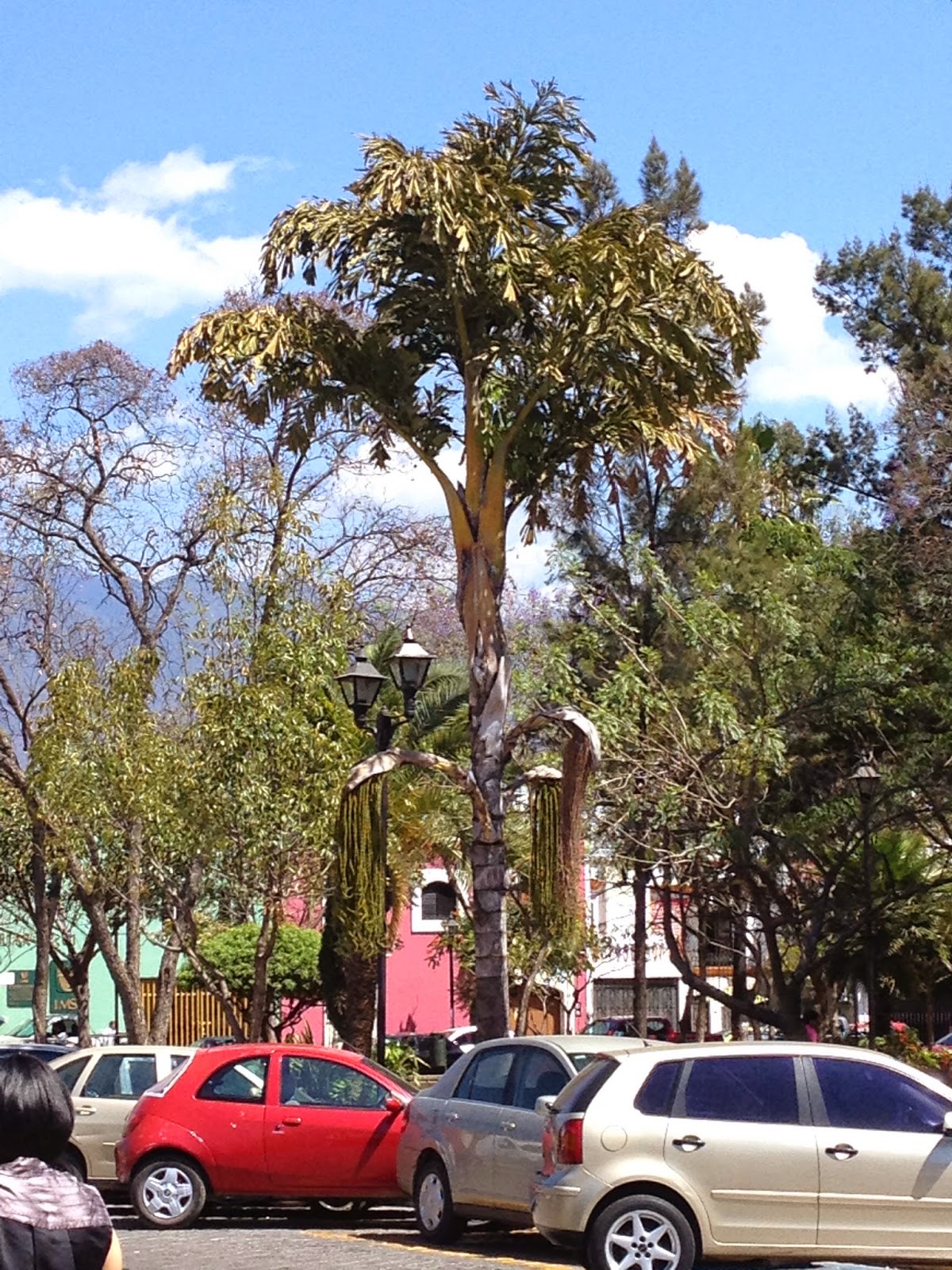
We never did figure out
what this tree is

I enjoyed learning something about Mexican history while we were here. Not that I have become an expert, or plan on going back to school to become one. In fact, maybe it's just that I knew pretty much nothing about Mexican history and was embarrassed into studying up on it.

Finally, I got better at communicating with Spanish-speaking people. I still stop short of calling it Speaking Spanish. There are still a lot of hand gestures and blank stares, but it's a lot better than it was. 

What worked, what didn't? 
Cooking intercambio at our house with
friends from the U.S., Mexico and Japan.
Spanish was the only common language.
We set out to structure our time, to be intentional about how we spend this precious break from our regular lives. We used our calendars to put into our days those things that we wanted to make sure we got to. This was at the advice of the TED Talk, "The Power of Time Off" by Stefan Sagmeister. This was good advice, and it has served us well.

Sarah's original plan to find a job teaching English didn't pan out. Here in Mexico, you can't take a job that a Mexican can do, but teaching English is one of the jobs that is OK for us "gringos". However, when we got here, Sarah found that it wasn't that easy to find a job, and those that were available were very low paying. So she decided instead to volunteer at En Via.

Randy found himself selling
wicking beds at the Library Bazaar
One of the things that Randy set out to do was to cook. He had visions of taking cooking classes, shopping daily at the open markets for fresh meat and produce, following traditional Oaxaca recipes, and having dinner waiting for Sarah on the table when she got home from her job teaching English. As it turned out, Sarah didn't get the job, and Randy didn't cook. Except for breakfasts, which he cooked every morning. He did hunt down "huevos criollos" (heirloom chicken eggs) at the open markets, but he got his fresh fruit mostly from the convenience store across the street. 

What advice can we offer? 

If you are thinking of taking a Sabbatical, we can offer a few suggestions, from our experience.

We think it is important to get away from home, physically. That way you don't let your time slip away with day to day care for the house, the yard, etc. Sure, bathroom water came through the kitchen ceiling in our house back on York Avenue in Minneapolis, but - case in point - all we could do from here was make a few phone calls.

Randy giving a tour of El Pedregal
We also suggest that you have a plan to get involved in a project or two. Something new. Something a little outside of your comfort zone. If you can do it on a volunteer basis, then your options are much more open. We both benefited greatly from our volunteer gigs, and learned a lot about ourselves and the world in the process.

But more than anything, we suggest that, if you get half a chance, you GO FOR IT. There will always be issues to work through, timing problems, and other possible excuses. But if the stars align and you get a chance to take a Sabbatical, do it. There is no way around pulling the trigger when you have skin in the game (wow, how's that for mixed metaphors?). 

What do we think will be different going forward? 

First, we hope to do it again next year. We found a place here in Oaxaca for next winter.  Sarah is putting out feelers about private English classes she'd like to offer, and has already been invited back to do translation work for En Vía.  Randy built some compost piles (based on what he learned at El Pedregal) at the property of some friends here in Oaxaca, and hopes to collaborate with them in selling compost in the future. 

We appreciated having so much time to meet
and spend with new friends.
Finally, we hope to carry with us back to the States our new attitudes toward family, work and life. We hope to spend more time with our kids, and to be more present when we are with them. We plan to choose our work to suit our lives, and not just to work to make a living. And we hope to carry back with us the Mexican enjoyment of life - stopping to chat when we run into people, eating well and often, and walking a lot. I guess we'll just have to wait and see how much of that sticks. 


Thursday, March 12, 2015

What could go Wrong? (Part 2)

We just find this theme so ripe with examples that we felt it was worthy of an encore.

In the following video, a man dances around with an animal-shaped thing on his head that spits sparks  all over the crowd. People hold their collars tight against their necks to keep out the sparks!


A power company worker
leans his ladder against the power lines.


If there is not going to be a riot,
why do they have all that riot gear? 


At Hierve el Agua - and really everywhere else - there are no barriers
to keep you from walking to (or off) the edge of a cliff.

Pochote trees are everywhere and their spines are
needle-sharp. Definitely not for treehuggers.

Meat doesn't need to be refrigerated, does it?


These kids play music from the rooftop of the church
in Teotitlán to ring in the Fridays of Lent. I'm sure
they're very careful up there, as teenagers tend to be.
And here's what happens when things really go wrong.
The town of Huayapam has a couple of holding cells
right in the town square, usually reserved for the drunk
and disorderly. We don't know if that was the case for our
friend, Willy. :)


Wednesday, March 4, 2015

Things want to Live

Our friend Juan examines the
plants growing in the cracks at
Monte Alban.
Anywhere there is a bit of dirt, some sun, and a
hint of water will do.

Here in Oaxaca, things want to live. In cracks, on roof tiles, in this soil that looks to my Minnesota eyes like bare subsoil, things want to live. Here is a collection of photos by Sarah, the official photographer of our 2014-15 Sabbatical.


To propagate Plumeria, they bury one end
of a branch in the ground. And it grows. And it blooms. 


Weed growing out of the ancient aqueduct.


Plants growing in the roof gutters above.

Agave getting ready to bloom and die,
it puts up what looks to me like a giant asparagus spear. 

These things want to grow
 in wicking beds on a windy, full sun roof top.

There is no name for Morning Glories down here,
I guess they are just another weed growing in the cracks.

Lechuga Gonzales Tortuga, our temporary pet,
greedily devouring lettuce.

This Ficus tree, planted in a small hole in the sidewalk
outside our house years ago,
now makes the driveway unusable.


Don Pedro's Bulls. 


This looks to me like a hostile environment,
but it's just another ficus growing into concrete


If I can keep California red wigglers alive,
they must really want to live!

Saturday, February 14, 2015

Trees of Oaxaca (Part 2)

As I understand it, here in Oaxaca plants under stress for lack of water flower in a desperate attempt to reproduce. If they can't survive, at least their offspring might. For the plants, that seems kind of sad. But for us humans, this makes for a colorful show of flowers just as the grasses are turning brown. So, many of the trees that were of little notice when we arrived back in October (at the end of the rainy season) are now blazing with color and attracting my attention, for one. If you are here for the the "Mystery Tree" contest, read on...


Jacaranda Tree-
This shaggy-looking legume (above left) is everywhere in Oaxaca. Since we arrived it has had hard, rounded bean pods. Here (above right) is what it looks like in February!


Framboya (Delonix regia) - in Spanish, "Framboyan"- one of several trees known as the "flame tree". It is so beautiful in bloom (below left) that it's hard to find pictures of it NOT in bloom (below right).


Primavera (Spanish for the season, "Spring") or Trumpet tree (genus Tabebuia),  - explodes in yellow flowers early February. This time, NO photos of this tree before it bloomed!


Plumeria - planted as propped up sticks in the ground (below left), grow in all kinds of tough urban settings, and bloom beautifully (below right).

You may recall this scene from
a previous post ("What could go Wrong?"),
before these Plumerias were "planted" 

Orchid Tree (genus Bauhinia, species ???) - I swear there is an Orchid Tree in Llano park that has been blooming the whole time we have been here. The flowers on this tree are lovely, and of varied colors, the leaves look like little green butterflies, and it also produces nice light green bean pods.


Montezuma cypress (Taxodium mucronatum) -"The Tree of Tule" (TUH-lee).
Tule Tree from under the canopy

This specimen is a massive 2,000 year old tree with a 46 foot diameter (they say it's the biggest diameter of any tree in the world), on the grounds of an old church in the town of Tule, a pleasant day trip by bus from Oaxaca City. Not sure if/when it flowers, but I did hear that it is dying. In any case, it demands one's attention with or without flowers!
Tule Tree Dwarfing the church


Mystery Tree: identify the tree below, post your answer on the blog as a comment, and you will be eligible for valuable prizes*.
Name that tree!   

Sunday, February 8, 2015

I Get Around

I do get around here in Oaxaca, but it's not always easy!

Let's start with the street names and I don't mean the actual names, which can be for Nauhatl gods and have 4-5 consonants strung together. I'm talking about the system. The two major streets are Independencia, which runs east-west, and Alcalá, which runs north-south. These two streets maintain their names all through town. All the other streets have one name until they intersect with either of those main streets, then they change to a different name. For example, Pino Suarez north of Independencia becomes Xicotencatl to the south, and (one of my favorites) the exotic-sounding Cosijopii turns into the pedestrian Humboldt once it crosses Alcalá. So, basically, there is a different set of street names in each quadrant of the city. Some people think it makes things easier to find and I would agree with that, EXCEPT-

Despite the inconsistent street names, I do appreciate that the city is -for the most part -laid out in a tidy grid.

Certain street names are used more than once, in completely different parts of the city. We have a Porfirio Diaz running through El Centro (until it becomes 20 de Noviembre) and another that cuts through the Reforma neighborhood (and of course, Reforma is not only the name of a "colonia" or neighborhood, it is also a street in El Centro (until it becomes Fiallo). So basically, you have continuous streets that change names and names that change streets. In order for any of this to be helpful you have to know 2 things about your destination. One is which colonia it's in. The OTHER-

This driver was great. Once we told him the cross-streets
he was happy to stick our 2-by-4 through his window.
Okay, this segues into taxis. It's pretty easy to walk just about anywhere in this town but now and then we need to hail a cab. They're ubiquitous and cheap but we found there is another price to be paid if you don't know the protocol. First, you tell the driver the colonia of your destination, like Reforma, and you verify how much it will cost (you will only forget that step once). Once you are en route, you tell him the cross-streets of your destination, for example Cosijopii and Xicotencatl (although this would not be an actual destination because, well, the quadrants don't match). Do NOT tell the driver the address of the place you're going. If you do, he will again ask for the cross-street. Addresses have little-to-no-significance here. But cross-streets are indispensible. If you do not know the cross-street the driver will start talking ridiculously fast in Spanish and the only thing you will understand is that he is shaming you for only knowing the address. And you will certainly not reach your destination. If you are just going around town, do not mistake a TAXI for a COLECTIVO-

Unbelievably, our entire family of 6 "fit" in a colectivo for
the hour-long drive out to Mitla. It helps if you all know and
love each other.
This is a close cousin that looks like a taxi (except it's maroon) but functions like a bus. They go to specific pueblos which are advertised on the windshield and pick up passengers along the way. They stop (or slow down) at certain spots and the driver hollers out the window at the people waiting and holds up the number of fingers that corresponds with the number of available "seats." A word of advice here: do not sit in the front seat. Sure, it looks more comfortable than cramming in the back with a couple of strangers but only until passenger #5 gets in down the road. Then whoever was enjoying that spacious front seat has to scoot over and pretty much sit on the stick shift. And there is usually a fifth passenger. This is when you wish you'd taken a different OPTION -

Fringe, fur-framed mirrors and rosaries decorate the windshield
of any serious bus driver. I just noticed the shoes while posting
this...original touch.
The bus. We've wondered why all the busses look different and there doesn't really seem to be any schedules. We just found out that private individuals pay ~400 pesos a day to rent a bus, then they keep all the proceeds. So I guess you get whatever bus you can and then drive it...whenever. All the busses are different structurally but they all have shrines on the windowshields and dashboards, usually to the Virgin of Juquila. And they all have music playing full-blast. I kind of enjoy this when it's traditional Mexican music but ocassionally you get a driver with a love of heavy-metal. Makes for a long ride. But you know what I love about the busses? If you are in the middle of a block and the bus is coming you just step out into the street and raise your hand and the bus stops for you. Not like in the U.S. where you get punished for not being at the authorized stop and the driver scowls at you as he speeds by. It's not all benevolent, though; the driver makes his money per passenger, so of course he'll accomodate you. But there is really only one way to be on your own SCHEDULE-

Signing up for the rental bikes in Mexico City, aka D.F.
I've always been skeptical of renting a bike in a strange city (like Nice Ride or City Bike) because I think it looks dangerous to be in traffic, looking around, wondering where you're going, without some metal between you and whatever may hit you. And I have not yet riden a bike in Oaxaca. But, for some reason, we thought this would be a good idea while in Mexico City (pop. 28,000,000, every resident with a car). We had a few people honk at us, but we got so comfortable we were even biking at night.

There are several other transportation options here, like moto-taxis and vans - all of which seemed confusing and foreign to us at first but now are just other ways I Get Around.
I met Martina on an En Vía tour. We ran into each other
several times in Oaxaca, but running into each other in
D.F. made us think it is our fate to stay in touch!