Tuesday, November 18, 2014

Moving - again

Our casita.
We have moved more in the past 3 months than we have in the past 23 years. We were lucky to find fabulous renters for our house in Linden Hills - the only catch was that they wanted to move in before we were planning to move out. Then we got lucky again, when a friend offered us his duplex on 50th and Lyndale for the 6 weeks that we would be homeless in Minneapolis.

We were planning to rent the "perfect" place in Oaxaca - 4 bedrooms, right by the aquaduct in El Centro, for a reasonable price. It was too good to be true - seriously! In July, we found out the house had sold and was no longer available. We found another great place but it wasn't available until November, so we made arrangements to stay with Maria and Manuel, whom we'd stayed with before, for the month of October.
The bedroom at M&M's served as an office, too.
With all the fabulous tiles in Mexico,
why this?
Room with a view - the kitchen looked
onto the common patio.
"Lechuga" used to wait outside our door
when she was hungry!
Enrique, María, and Randy before the race.
Maria and Manuel's place had some issues: bedroom+bathroom+kitchen = a lot of togetherness :); our bedroom was directly on a street that didn't seem particulary busy until you were lying in bed, listening to the cars, motorcycles, passers-by, etc.; the guest renting the unit across the patio who coughed chronically and whose smoke drifted into our place. But it was in a great location and Maria and Manuel had us doing things we may not have done otherwise, like participating in a 5K that their son organized, visiting their event center, and learning how to get a water tank on to the azotea (roof terrace).

Our new place is a little further away from the action but offers the amenities that come with a neighborhood - the shopkeepers ask your name, you recognize your neighbors and things are a bit quieter. Wait, scratch that last part. We are next door to a dance studio (remember, no zoning laws in this truly free country) and if you've ever taken a dance class you will remember that a few bars of a song are played, then repeated...repeated...repeated...Drowned out only by the dogs barking. And the birds. And the guy in the tamale truck (thank God 10:00 p.m. is last call). Someone commented to us that Mexicans have a "different relationship with noise" than Americans do. So, as part of the immersion, we're embracing the music and the dogs and we're considering running out for a tamale next time he comes down our street.
We can seat more than 2 people now.
We have a living room.
The kitchen.

Happy to have an oven - even if the only temperature setting is 400.

A bathroom with a separate shower.

While Sarah was searching for a place to rent on various websites, she found that the places advertised on English-speaking sites (and offered, usually, by North Americans) looked so "Mexican" with bright colors, lots of artwork, beautiful tiles, while the places on Spanish-speaking sites were very sparsely furnished, typically with a big, black sofa set and TV in the living room and very little else. The prices reflected the difference and in the end we went with a Casa Gringa. We have to admit, we're quite happy to have the ameneties (like a bathroom that doesn't become the shower) and to be surrounded by the beauty of our new casita. Yup, quite happy.


Thursday, November 13, 2014

Garden Quick Tour

OK, so this one is REALLY not for everyone, but if you are interested in a quick tour of our home garden here in Oaxaca, read on...

Our house comes with a gardener, Rigo. He comes twice a month to attend our patio shade garden. Much of what he does is remove the clutter that falls from the trees and bushes. I asked him if it would not be better to leave the mulch on the ground, and his eyes lit up. He knows that the organic material, if left on the soil, would be beneficial to the soil and all of the plants in it. But he says everyone here considers it "basura" (trash), so they pay him to clean it up. I asked him to bag it up and let me add it to my compost pile.

Rigo on his first visit was kind enough to share with me the names of all of the plants. From my conversation with him (in Spanish), and my rough notes from that meeting, I was miraculously able to find information on some of the plants on our patio to share with you here (the single-plant photos are NOT from our patio, but I think they are better for identifying the plants).


"ficus"
Ficus Tree (Ficus benjamina) 
Back in Minnesota, this is grown as a houseplant. In this climate, it grows into a 100 foot tree, ripping up sidewalks with it's powerful roots. We have one just outside our front gate, which provides shade for everything else that grows in our front patio area.
Fun fact: Ficus benjamina has been shown to effectively remove gaseous formaldehyde from indoor air.


"pochote"
Pochote Tree (Pachira quinata)
Once inside our courtyard, the centerpiece is the Pochote tree. It is easy to identify by the protective thorns on it's trunk. I have a couple of times forgotten about the sharp tips and drawn blood! Both organic markets here are named "Mercado de Pochote", and although the two markets emerged from the same organization over the years, it is not clear to us whether the markets are named after the tree (which can be found at both markets) or if there is some greater significance to the name.
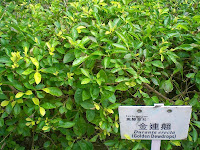


"duranta"
Golden Dewdrops (Duranta erecta)
Ringing the Pochote in a neat hedge is what Rigo called "Duranta". The leaves and berries of the plant are toxic, and are confirmed to have killed children, dogs and cats! However, songbirds eat the fruit without ill effects. And it is said to attract butterflies and hummingbirds. Rigo suggested that I water these them most heavily of all the plants in the garden.


Pasto Liriope


Lilyturf (Liriope muscari)
Outside the Duranta ring around the Pochote is what Rigo called "Pasto Liriope". "Pasto", I know from working in the fields at El Pedregal, means "grass". It looks like a nice ground-cover which produces a pretty purple grape hyacinth-like flower in late summer, so I guess we missed it. It is said to be "deer resistant", and grows in zone 6, for those of you fighting that battle. Roots are apparently used in traditional Chinese medicine.


"Lirio"
Creeping lilyturf  (Liriope spicata),
What Rigo called "Lirio", this shorter cousin of the Liriope Grass (above) is a ground cover that is good down to Zone 4. Finally something that I can grow in Minnesota! But it spreads aggressively, so apparently it needs to be bordered by concrete (which makes me wonder if I have not misidentified this one).  Liriope spicata filters formaldehyde, ammonia, xylene and toluene from the air. And it's good for holding the soil on a steep slope.


"Cingonia"

Syngonium (syngonium podophyllum), Arrowhead vine, Goosefoot
Rigo sent me on a wild goose(foot) chase when he called this "Cingonia". This climber is normally considered a houseplant, but here at our place it is a vining perennial out in the garden.


Espada de Angel
Snake Plant, (Sansevieria trifasciata)
This is what Rigo called "Espada de Angel",  Spanish for "Angel's Sword. Needs very little light, and almost no water in winter. Rigo told me I don't need to water this one. Fun fact: A study by NASA found that it is one of the best plants for improving indoor air quality by passively absorbing toxins such as nitrogen oxides and formaldehyde. 


Yerba Santa (Piper auritum)
"Yerba Santa"
Also known as hoja santa, hierba santa, Mexican pepper leaf, acuyo, tlanepa, anisillo, root beer plant, and sacred pepper. I figured any plant with that many names must be important. And sure enough, the leaves are used in cooking with chicken, in making tamales and mole verde, flavoring soups, chocolate drinks, liquors, teas and cheese. Not bad for a shade loving perennial! Note the distinctive white pencil-like flowers.


Rigo also identified for me a few potted plants, including…
"mala made",
spider plant
"Pata de Elefante",
Elephant Foot 
…and a few that Sarah helped identify...

Jade Plant
Croton

potted palm


Geranium

Putting it all together, here is the mistress of the property enjoying her garden:
Watch your fingers, Dear!

lots of shady characters lurk in the garden.


But don't you believe for a minute that this is the last you'll hear from me about plants, no, far from it. In addition to collecting more information about the local trees and other plants, I started a veggie and herb garden (ok, so far it's just an herb garden) on the roof, so you will probably see pictures of that soon. So for those of you who gave me encouragement after posting about the "Guage" Tree, look out!

Monday, November 10, 2014

Fundación En Vía

Silva starts making tortillas at 4:00 a.m. to
avoid the heat of the day.
Karen is an 18-year-old
euntreprenuer.
Mole negro at The Jaguar Café.
When Randy and I were in Oaxaca 3 years ago, we took a tour with the organization Fundación En Vía  http://www.envia.org/. Their mission is: to support the creation and growth of income-generating businesses that promote the well-being of families, and the strengthening of communites by using microfinance, responsible tourism, and educational programs.

The main idea behind microfinance is that many people living in poverty have the skills, motivation, work ethic and ideas to operate successful businesses but they lack things like affordable loans, a place for savings, insurance, etc. Microloans are readily available in Mexico - with average interest rates of 70%!

The view from the churchyard in Teotitlan.
The tour took us to 2 pueblos outside of the city of Oaxaca where we met 6 women who had received interest-free microloans from En Vía (obtained through tour fees, the responsible tourism piece). We had lunch at the restaurant of one woman; we visited the homes of 2 weavers and a shoe seller; we ended by visiting a mother who sold garlic and her daughter who sold a Mary Kay-like line of cosmetics - to her high school friends! They were all able to start or expand their businesses thanks to En Vía. Although some of the lives - and certainly living conditions - still seemed incredibly harsh to us, it was clear that all these women were so grateful for the improvements and hope that these loans made possible. And as I found with "my refugees" when I was teaching in MN, the focus is mostly on insuring a better life for their children. A lot of the women proudly announce that their kids are attending high school (which, in many towns, is not free, or at least has costs attached).

Some of the elders in the communities
speak only Zapotec.
Andrea provides payment plans for her customers.
This artist draws the design, then weaves it into a tapete.
I had planned on teaching English while I was here - and En Via's education arm offers English classes in two of the pueblos - but when they asked if I'd lead the tours I jumped on the chance to do something different. And it's been great! I've met really interesting people (co-workers, tourists, and the borrowers) and seen and learned a lot about the 6 communities where we work.

María demonstrates spinning her own wool.
A town we go to often is Teotitlan de Valle, which is famous for its weavers. Some of the women card, spin and dye their own wool. Many use natural dye made from ingredients that they find in nature, such as insects, flowers, and tree bark. They all use the traditional peddle-looms. En Vía has helped these women buy materials in bulk, which saves money and allows them to buy during the slow sale times and prepare for the busy ones. Many of the weavers are now able to sell their "tapetes" or rugs, directly instead of going through one of the "Casas Grandes" or Big Houses that take a large percentage of the sales.
Veronica sells desserts around Santa Domingo
by bicycle.


My commute. It sure beats I-94!
Other businesses include a woman selling desserts from her bicycle, a pig famer, a chocolate maker, tortilla makers, and an 18-year-old with her own beauty salon (I'm sending Randy there for a haircut!). The tour is a great way to get to know a bit about these women, their businesses and the lives they lead. It's so inspiring to see what people can do when they are offered the opportunity!

Common colors for yarn, made with natural products, such as...
...the white on these nopal paddles are insects
called cochinea and are used to make red dyes.
Rafaela grinds the cochinea, the first step in the dying process.

Friday, November 7, 2014

Sabbatical - What's in a name?

I have been doing some thinking, reading and meditating on the concept of Sabbatical over the past few months. This has been part of my own personal Getting Ready before we left the US, and part of my process now that we are here in Oaxaca.

The first thing that was helpful was watching the TED Talk, "The Power of Time Off" by Stefan Sagmeister. The speaker has developed a practice of taking a full year Sabbatical every 7 years. He says he wasted the first one for lack of structure, and did much better on his second one by having a weekly schedule, like the ones we had back in school. I took this advise to heart, and came up with a rough plan for my time, though I will say life does not always cooperate with your plans and theories. Still, I find it helpful in making sure my time is spent intentionally, not eaten up by email and FB. :-)

The second thing that was helpful for me in Getting Ready was that Travis Norvell (our pastor at Judson Church in Minneapolis) loaned me a couple of books on the subject.   "The Sabbath: Its Meaning for Modern Man" by Abraham Joshua Heschel gave me a view of how the Sabbath is observed and experienced from a Jewish Rabbi's point of view. Heschel refers to the Sabbath as more than just a day to relax in preparation for another day of work, but as a taste of eternity. He says that the coming of the Sabbath is greeted ceremoniously as a bride is greeted on her wedding day.  "Receiving the Day: Christian Practices for Opening the Gift of Time" by Dorothy C. Bass explored the practical, modern aspects of practicing a weekly Sabbath. She points out that Sabbath is about saying "no" to say "yes" (not a new idea), and that the saying "no" is at times not easy. Sarah and I are trying to clear away time on Sundays to spend together doing nothing much except taking leisurely walks and talking.

El Pedregal ("The Rocky Field"),
the permaculture site where I am volunteering this winter.

A Sabbatical to me is different from a vacation. A vacation is a break from work where you maybe get out of town, rest, do as little as you like, indulge yourself, and then come back to work, hopefully refreshed and ready to go. A Sabbatical, on the other hand, is not just a break FROM, it is a break TO - in order TO do something. We have been to Oaxaca twice before on vacation, and we had a great break FROM work, sleeping in, eating in restaurants, seeing the sights, trying out our Spanish. But this time we are here more TO do things - TO volunteer, TO improve our Spanish, TO meet people and in my case TO explore new vocational possibilities. We expect this Sabbatical to to change us, not just refresh us.
My commute.

The parents of some of Hannah's friends came to visit for "Dia de Muertos", and they used a term to describe what we are doing that I had not yet heard ..."Mid-Life Gap Year"…but I am not sure it fits as well for me as Sabbatical. I am certainly in "Mid-Life", so that fits. But to borrow the term "Gap Year" from high school kids who delay starting college doesn't really work for me. First, the kids presumably know what they are going to do the following year, maybe even where they are going. And I have to admit the suspicious parent in me thinks they are just trying to delay having to do the work required of a college student, and to prolong their childhood dependency on their parents another year! So I guess for me the word Sabbatical has weight and power, whereas "Gap Year" sounds like something missing from your resume.

Whatever you call it, this is an experience that everyone should be able to have, that everyone deserves, but few ever get. I think everyone should be given a year off when they turn 50. Few are "given" a Sabbatical, but I encourage anyone who can pull it off to "take" one.
Just a friendly reminder that
nobody lives forever


Sunday, November 2, 2014

Día de Muertos


The hostess at one of our favorite restaurants.
Apparently silicone survives death.
One of the celebrations Oaxaca is well-known for, in addition to Night of the Radishes (I can't wait for that one!), is Day of the Dead. The streets are teeming with tourists anxious to experience this 3-day spectacle which includes parades, fireworks, costumes, decorated altars, tapetes de arena (sand carpets), and visits to local cemeteries.

Death as an extension of life.
Beginning on October 31, people begin preparing for the return of the spirits of deceased loved ones. Gravesites are cleaned and decorated with marigolds, celosia, lilies and candles. Families gather together at the site, eating, drinking, remembering, and ocassionally playing music and singing. Día de los Angelitos is celebrated on November 1, in rememberance of infants and children, and on November 2 all others are honored

A typical alter with the favorite foods of the deceased. After
the deceased has consumed the "essence" of the food, the
family can dig in.


We've been swept up in it all.  Friday night we went to the cemetary in Xoxocotlan (nicknamed Ho-Ho) to see the decoration of the gravesites. I couldn't believe what met us there; street musicians, hawkers selling all sorts of illuminated props, strangers offering us shots of mezcal, a stage with performers (including some traditional Tunas from Spain). And some of the altars created at the tombs were incredible.

These new friends were anxious to share
their beer with us!
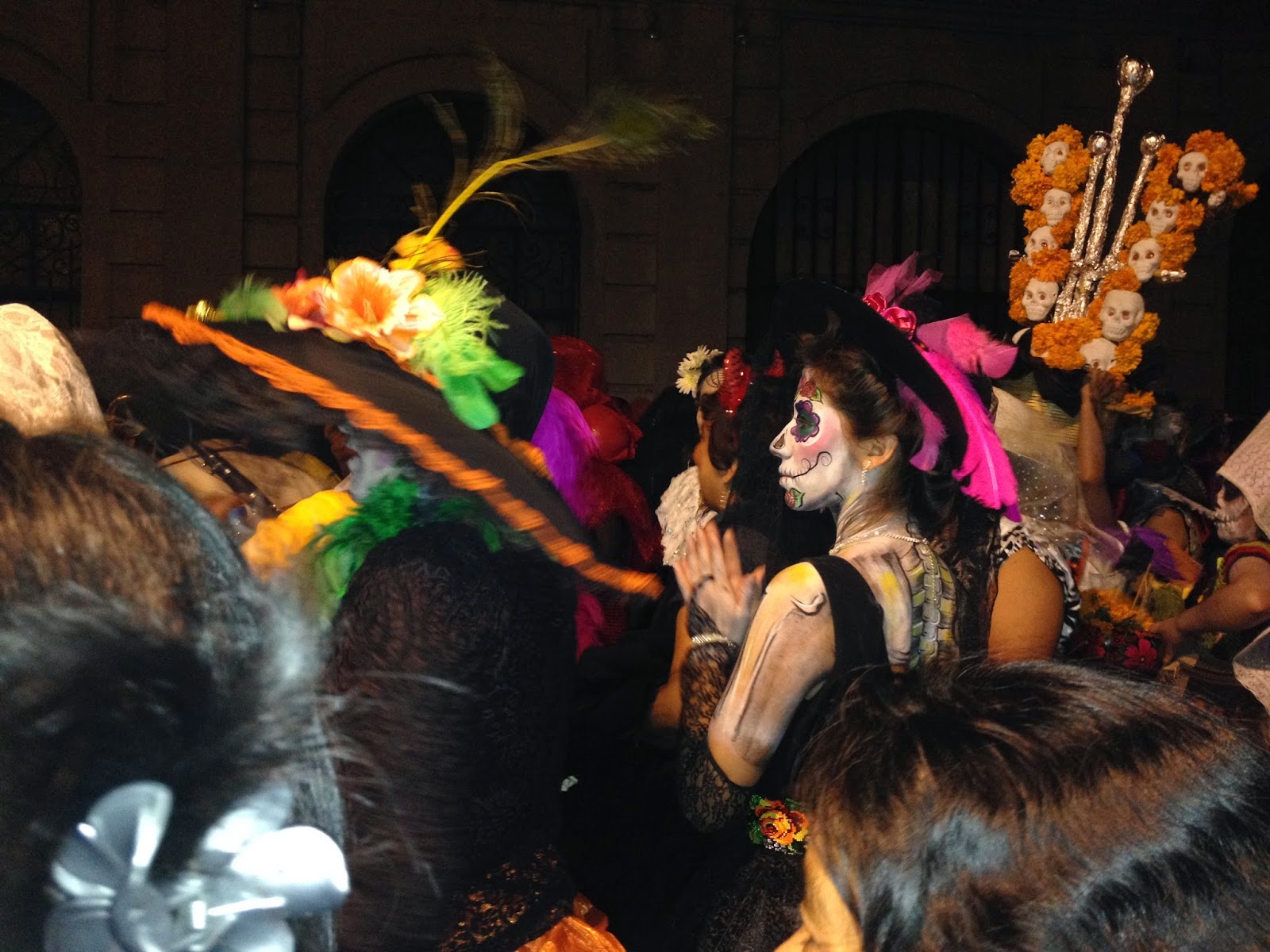
Parade of the Catrinas on Saturday night.


This is all what I had been prepared to expect. Ironically, what I hadn't expected was the grief. Most families seemed serene, even joyful, as they decorated and tended their loved-ones graves but there were some who were expereincing the raw pain of loss. With a lot of people watching them. But what surprised me most was the grief that I felt at the sight of the lonely graves, the ones that were not decorated and seemed forgotten, especially when they were next to those that were so lovingly cared for. Randy and I bought a bunch of marigolds, put flowers on some of those bare spots and wondered what the stories were behind them.
Many of the crypts in the San Miguel cemetery hold remains
of "desconocidos" or unknown people.

 My Dad died almost one year ago and Randy's Mom has been gone for 7. We created an altar for them in our casita, with the traditional sugar skulls, candles and favorite foods. I spent time thinking about what my Dad liked in life, great times we had together, sayings he had ("It's better than I deserve," "I fell uphill," "There's nothing better for you").  The atmosphere in Oaxaca has helped to keep his memory close these days.
Our alter included art supplies and candy
 for Judy; coffee and peanuts for my Dad.

A tapete de arena, or sand carpet.
Día de Muertos is such an odd combination of grief, celebration, entertainment, reflection, letting go and holding on. Just like life, I guess.